February 23, 2015 - Comments Off on Foot in the Door Technique

Foot in the Door Technique

Word: Foot in the door technique

Definition: The persuasion tactic of asking for something small from someone and then following up with a larger ask if they comply to the first.

Reference: The sales technique is named for that literal practice of physically putting a foot between a door and a door-frame in order to stop the door from being closed closed, or slammed for that matter, in one's face.

The foot in the door phenomenon was first studied in 1966 by Stanford University psychologists Jonathan Freedman and Scott Fraser. That year Freeman and Fraser published a landmark study titled "Compliance Without Pressure: The Foot-in-the-Door Technique" in the Journal of Personality and Social Psychology (1966, Vol. 4, No. 2, 195-202). The study asked participants a question about household cleaners over the phone and then later followed up with a second ask on the same topic in person. Freeman and Fraser found that participants were 135% more likely to respond positively to the second request if they had responded positively to the first smaller ask over the phone.

Thought: Such a technique can be utilized in user experience. For example, a site could start by asking visitors for a very small piece of information about themselves, like an email or a zip code. This figuratively allows the site to put their foot in the door and set themselves up for a larger ask shortly there after. The user is much more likely to give up more information if they have already given up a little bit previously, and perhaps already gained some value from that first ask.

So stick your foot in that door people and then do your best to crack it wide open!

February 19, 2015 - Comments Off on Power Users

Power Users

Word: Power User

Definition: Someone who operates a computer or device at an advanced skill level with knowledge and/or experience that is not typical of an average user. Sometimes referred to as a super user. 

Thoughts: UX designers need to consider all user types when designing and that includes both the power user and the beginner. This can lead to a tricky situation because a dumbed-down interface will frustrate the power user, while a complex interface will scare off the beginner. There is no secret formula, unfortunately, but I can still offer a few helpful keep-in-the-back-of-your-mind thoughts!

Games are great examples of interfaces that progress as a user essentially levels-up and gains knowledge. This way it teaches a novice the basics while providing and unlocking features for the power user. As gamification continues to penetrate UX thinking, games can offer quite a bit of insight and inspiration.

However, another school of thought says that all products should be accessible and usable by everyone at all times and that the seamlessness integration of all types of users is the beauty of great design. I can dig this too!

Question: In what situations do you consider yourself a power user? As a power user do you look for VIP treatment?

February 18, 2015 - Comments Off on Fat Footer

Fat Footer

Word: Fat footer

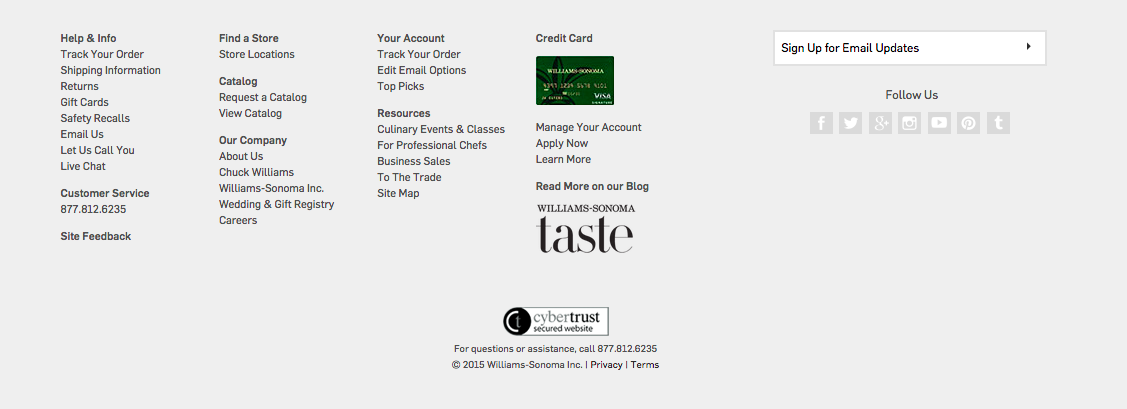
Definition: A form of secondary navigation located at the bottom of the page, typically taking up a considerable amount of page real-estate and serving as a shortcut to hierarchical content.


Screen Shot 2015-02-18 at 9.24.37 PM

Williams-Sonoma fat footer


Thoughts: Fat footers are typically used on sites with an incredible amount of information and lengthier page content. These sections are extremely helpful to link popular site content that may not be directly relevant to the selected page itself. It also acts as a visual anchor and an affordance that a page has come to an end while providing additional page view opportunities. Fat footers also present space for graphics, social media links, and newsletter promotions. These big guys have graduated from more than just links lists.

While I know this may come off as a broken record to you consistent "UX 365" readers, but there is a debate on this topic amongst us! While there are clear benefits to such "obese footers" (as Jakob Nielsen once called them), there are also thoughts of too many links and a persistent feeling of "spamminess".

Both points are well taken and I venture to guess that like with most polarizing topics, it comes down to a case by case basis with specific business goals in mind.

Question: How does the persistence of continuous scroll effect the future of the footer, regardless of its size?

February 17, 2015 - Comments Off on Mobile-Centrism

Mobile-Centrism

Word: Mobile-centrism

Definition: Dependance on and around mobile devices in a way that goes beyond sheer usage and into lifestyle and activity penetration.

Thoughts: This word was first brought to my attention in the Smashing Magazine article about mobile use in China. In China, as of June 2014, more people accessed the internet via mobile than via PC. This growth has led designers to move beyond "mobile-first" and into the mindset of "mobile-only", bypassing desktop and relegating it to an afterthought.

In China, the mobile-centrism is so strong that a user's cell phone number can be equated to the value of a US social security number with people using their mobile numbers for everything from digital wallets, to proof of ID, to login-in credentials.

While China is leading the way in mobile access and centrism, the US has seen its own uptick in lifestyle infiltration, particularly when it comes to e-commerce. Mobile payments and mobile wallets are likely to only get stronger and more widespread in the coming years.

As UX designers we know the power and prevalence of mobile and it's exciting to think about how this saturation will further penetrate lifestyle.

Question: Can you foresee the rest of world catching up with China's current mobile practices in the near future? If not, what might happen if the rest of the world does not follow suit?

February 16, 2015 - Comments Off on Status Quo Bias

Status Quo Bias

Word: Status quo bias

Definition: The cognitive bias that says people typically prefer consistency over change. The tendency to like things to stay relatively the same, which forms a baseline in the mind. Any change from this consistent baseline is perceived as a loss.

Thought: This psychological principle plays into the theory of loss aversion. Status quo bias can be reduced however, by exposing users to other choices (assuming, somewhat obviously, that those choices were equivalent or better than the current option). The lesson here is that change is best accepted by users when introduced incrementally.

In Chris Nodder's book Evil By Design he uses an amazing metaphor to describe illustrate this cognitive principle,

"If you place a frog in hot water, it does its best to hop straight out. However, if you place it in cold water and then heat the water up slowly enough, the frog won't attempt to jump out."

Essentially, Nodder wants us all to think of our users as frogs, and I'm down with that!

Question: Can you think of a good example that refutes this? How can we make the frog stay in the hot water from the beginning?

February 15, 2015 - Comments Off on Enterprise Software

Enterprise Software

Word: Enterprise software

Definition: Software, sometimes referred to as B2B, is designed to solve  internal organizational needs. These organizations can include businesses, schools, retailers, and governments.

Thoughts: Essentially, enterprise software is used by employees, not consumers. While these internal applications and products are necessary to get work done and typically mandated within an organization, this does not mean they should be neglected. Employees are users too and organizations have begun to realize this. As a result, enterprise software has seen some increased love and attention from the UX community.

Enterprise is near and dear to my professional heart and I believe are at a point where great UX should be expected in all contexts. Productivity and user engagement should be at the forefront of all software development, even if it is not client or customer facing.

Read about recent enterprise love and attention here, here, and here. Dare I say, something once so mundane is getting trendy?!

Question: What's the worst enterprise software experience you have even been forced to endure? How would you fix it?

February 14, 2015 - Comments Off on Diary Studies

Diary Studies

Word: Diary studies

Definition: A form of qualitative research that is used to capture self-reported data from participants over a set amount of time, providing key information about how people use products in context.

Reference: Diary studies are not unique to user experience and were first utilized in a variety of other fields such as anthropology and psychology. They also a key research technique in the medical field during clinical trials or disease treatment.

Thoughts: While there are many different forms of diary studies and even more ways to conduct them, UserTesting.com defines the typical method as, "Users self-report their activities at regular intervals to create a log of their activities, thoughts, and frustrations."

Diary studies provide rich temporal and contextual insights that can help establish behavior patterns and demonstrate strong user habits and opinions.

February 13, 2015 - Comments Off on Double Diamond Process Model

Double Diamond Process Model

Word: Double diamond process model

Definition: A graphical representation of the design process by breaking it into phases (discover, define, develop, and deliver). Each mode of thinking is displayed through diverging and converging paths.

Reference: The model was developed by the UK Design Council in 2005 to simplify the mapping of the design process.

Thoughts: Yes, I know it kind of looks like a maze, but let's play follow the leader. The discovery portion typically includes a variety of research methodologies to better understand user needs. Next is the define phase is when the discoveries are aligned with business needs. This is followed by development where design solutions are developed and tested. And finally, the double diamond concludes with delivery, which includes final testing phases, approval and product launch. Don't forget, that the beauty of this method is the diverging and converging of phases. Make sure not to slip down the waterfall.


February 12, 2015 - Comments Off on One Eyeball, One Thumb

One Eyeball, One Thumb

Word: One eyeball, one thumb

Definition: A way to illustrate mobile usage patterns. The idea being that most mobile users tend to operate their devices with one hand while only partially paying attention.

Reference: The phrase was created by Luke Wroblewski in his book Mobile FirstIn the book Wroblewski writes,

"Thinking 'one eyeball, one thumb' forces you to simplify mobile designs so they can be understood and used in these kinds of situations."

Thoughts: A study in 2013 demonstrated that 75% of smartphone users still operate mobile devices with one hand (be that holding it with one hand or cradling it). It is also understood that many smartphone users do not give the device their full attention all the time. How often do you use your phone while watching TV, commuting, or even eating dinner?

The "one eyeball, one thumb" notion is a great way to keep designers honest and always thinking about how their work will be consumed and utilized.

Question: How, if at all, will the rise of larger screens (phablets) change the game?

February 11, 2015 - Comments Off on Minimum Viable Product (MVP)

Minimum Viable Product (MVP)

Word: Minimum Viable Product (MVP)

Definition: The smallest experiment that either proves or disproves assumptions about a business idea.

Thought: The MVP it is commonly misunderstand to mean the minimum feature set needed to create a working product. In that case, it might be better to use the MoSCoW Method instead which is created to facilitate feature prioritization.

Reference: The term minimum viable product was coined by SyncDev CEO Frank Robinson and later popularized by IMVU founder Eric Ries. For a deeper look on this topic the article "Putting the VP into MVP" on UX Booth is a great place to start.