All Posts in research

February 5, 2015 - 1 comment.

Information Architecture

Word: Information Architecture

Definition: "The art and science of organizing and labeling web sites, intranets, online communities and software to support usability and findability." - As defined by the Information Architecture Institute

Reference: Information architecture is performed by a variety of practitioners from specialized information architects themselves to more general UX researchers or even more broadly yet, UX/UI designers. However, and quite obviously, the disciplinary practice pulls from a variety of other subjects including library science, cognitive psychology, semiotics, cybernetics, discrete mathematics, and yes, even architecture. Information organization is not something that a UX designer should take lightly. Findability is an incredible component of what makes user experience so credible and invaluable to products, companies, and especially users.

Question:  It is easy to see how an information architect is extremely important when organizing a site with a plethora of information (think of the nightmare it was to do Amazon's IA). Is there ever a point when a site is too small for IA or IA does not need to be considered?


February 4, 2015 - Comments Off on Conversion Rate

Conversion Rate

Word: Conversion Rate

Definition: The percentage of users who take a desired action.

Thought: A frequently used example of conversion rate when it comes to UX is e-commerce. This would be the percentage of website visitors who buy something on the site. The Neilson Norman Group sums up the power of UX perfectly by stating, "Increased conversion is one of the strongest ROI arguments for better user experience and more user research."

Conversion rate is an important and qualitative way to measure performance over time and put an understandable and quantifiable statistic on the influence of UX practices. There is power in numbers, and strength in research. But remember, with great power comes great responsibility.

Question:  While e-commerce is the typical example of conversion rate, what other types of interactions are easily and effectively measured with this?

February 3, 2015 - Comments Off on Eye Tracking

Eye Tracking

Word: Eye Tracking

Definition: A usability testing technology that records and tracks what users are looking at and focusing on when skimming interfaces.

Thought: Eye tracking generates a variety of metrics that are extremely useful to researchers. These metrics include gaze plots, time taken for users to locate target areas, fixation points, and heat map visualizations. While such research methods require expensive equipment and considerable time investment, they provides insight into exactly what people are looking at. It is extremely difficult for someone to tell you precisely where her gaze is focused and what she sees. Eye tracking is a very accurate way to fully understand a user's exact visual focus and attention on a page. This method is most effective when combined with other research techniques and approached from both a qualitative and quantitate perspective. Keep and eye out for the opportunity to try this technique (pun intended).

Check out the F-pattern post for more on how users skim and understand interfaces.

Question: What sorts of interfaces do you think work best for eye tracking? On the other hand, what types of interfaces might eye tracking not be the most useful tool?

February 2, 2015 - Comments Off on Snowball Recruiting

Snowball Recruiting

Word: Snowball recruiting

Definition: A recruitment method where researchers ask existing subjects or people they know to spread the word and help generate participation from potential future subjects.

Thoughts: If each existing subject helps recruit one more participant, you can see how quickly the recruitment can, well, snowball! So why can't you do it yourself? Snowball recruiting can be extremely useful when research targets a very niche demographic or extremely specific community of users. It is also a great method to find participants that fall outside of your typical geographical area.

Researcher, Dana Chisnell did a wonderful interview with UIE where she discusses recruiting users with disabilities and how she utilizes snowball recruiting. It's a great read (or listen if you prefer the podcast!)

Question: In what types of situations have you used snowball recruiting? Do you see any pit-falls in recruiting this way?


January 30, 2015 - Comments Off on Contextual Inquiry

Contextual Inquiry

Word:  Contextual Inquiry

Definition: A research approach in which the researcher physically goes on-site to meet with participants. Once on-site, the researcher can interview and/or observe users in their normal working environments.

Thoughts: Contextual inquiry, like everything in life, has its benefits and pitfalls. Let's start with the good! Observing a user in their "natural habitat" will provide much richer and detailed information that may be extremely hard or even impossible to learn over the phone or in a constructed setting. Think about designing hospital enterprise software, for example. If you can watch how staff work together and you can observe their workflow first hand, this will be far more beneficial than having someone dictate process to you over the phone.

In a perfect world, most of us would prefer this method above all else. However, such research techniques are first and foremost time-consuming and expensive. As we all know, research tends to be one of the first areas to get cut from budget, so many times this is just not an option. Additionally, there are security, intellectual property, and intrusiveness concerns on top of everything else.

We could all use an opportunity to get off our tails and when such an approach makes sense, jump at the chance. Keep contextual inquiry in your research arsenal!

Questions: Have you ever been in a situation when a contextual inquiry did not go as planned? How about a time you learned something during a contextual inquiry that might never have come up otherwise?

January 27, 2015 - Comments Off on Open-Ended Questions

Open-Ended Questions

Word:  Open-ended questions

Definition: An open-ended question does not have a right or wrong answer. It doesn't even have pre-determined  ideas for what the answer might be. Such questions cannot be satisfied with a simple yes or no.

Thoughts: I know this seems like a simplistic word to define but it is so important to understand the art of question-asking when conducting user interviews. An open-ended question provides room for discoverability and this is where the heart of UX problem- solving lives! The  more open ended and vague your question is, the more room you give your user to dig deeply and thoughtfully. Don't be afraid of silence either. Users may shy away from open-ended questions by giving an insufficient answer. When this happens, let the silence permeate, and the user will likely expound on her answer to fill the awkward moment. Once the silence is filled, you will be glad your question gave room for it.

Questions: How do you utilize open-ended questions?

January 22, 2015 - Comments Off on Guerrilla Testing

Guerrilla Testing

Word:  Guerilla Testing

Definition: Guerrilla testing is summed up perfectly by designer Martin Belam, who describes the technique as “the art of pouncing on lone people in cafes and public spaces, [then] quickly filming them whilst they use a website for a couple of minutes.”

Thoughts: Guerrilla research has proven to be a cheap and efficient form of usability testing. Instead of recruiting participants, researchers bring prototypes to coffee shops or public areas and use compensation (like a small gift card) to incentivize strangers into testing their products for a few minutes.

While the technique definitely has its benefits, especially for cost and time, it is not the perfect solution in all cases. In order for this method of testing to be effective, for example, the product must not target a specific or niche user base because a random sample of people will not be representative of your end users.

Questions: Laura Klein recently wrote an article entitled "Stop Accosting People in Coffee Shops" in which she details the many ways that guerrilla testing is an insufficient form of research in many cases. How often to do you practice guerrilla testing? Are you using it properly or as an easy way out?

January 17, 2015 - Comments Off on User Journey

User Journey

Word:  User Journey

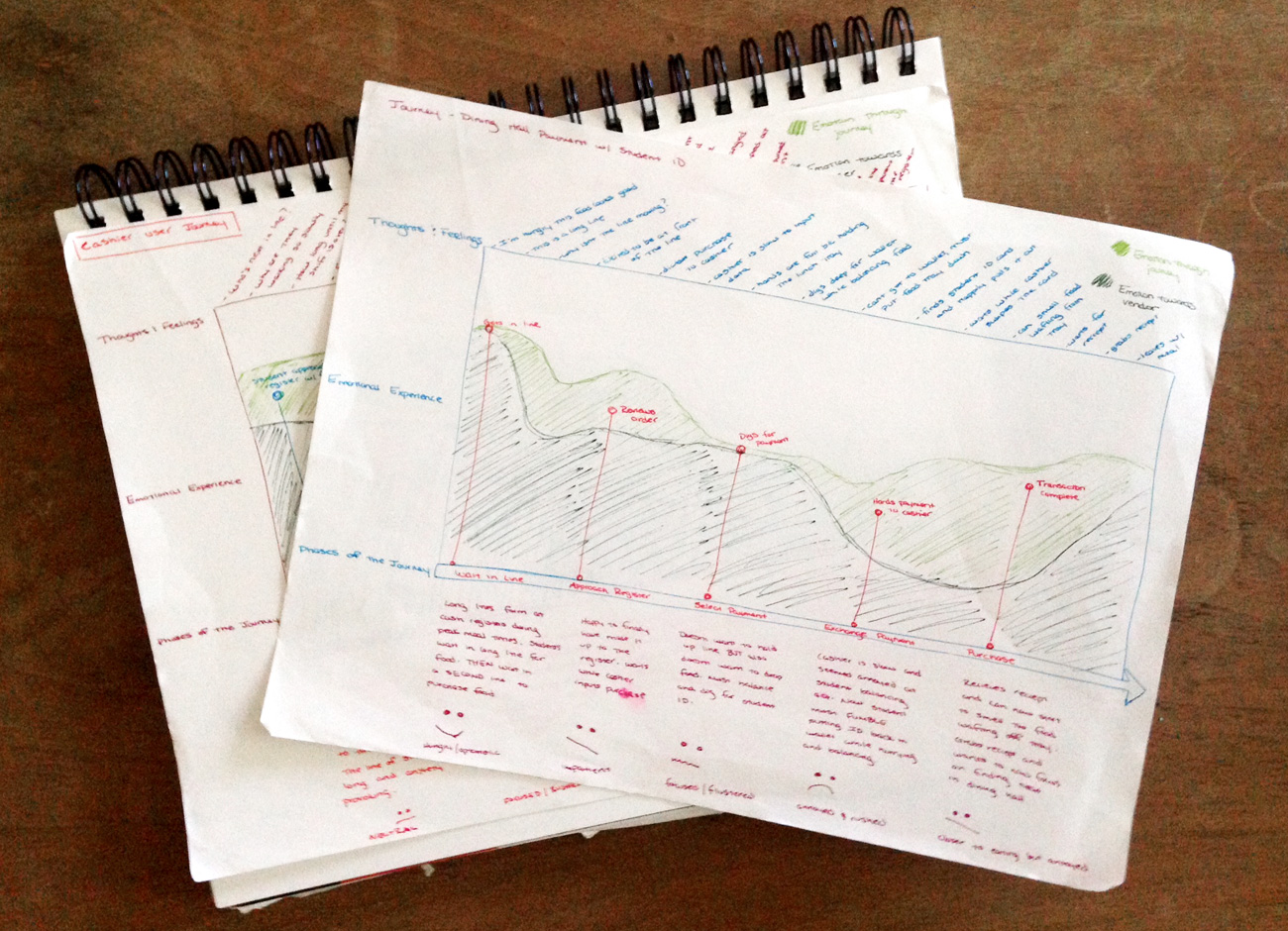
Definition: A map or diagram that illustrates the story of how a user experiences and interacts with a product or company. The story can be a small portion of the experience or an all-encompassing overview in order to provide insights into the user's thoughts, feelings, and motivations.

Thought:  User journeys are helpful to many people within a company, but the key takeaways for UX practitioners include uncovering pain points, understanding the user's unique perspective, and providing insight into user's decision making.

There is no formula for a user journey map. They can take any format you like, so long as it is simple and readable. This could be a timeline, an infographic, or a storyboard.

Word of warning, user journeys should be created from research and gathered information from users. This is not a free-form art class. No one is interested in your thoughts or speculations here.

Below is an example of one that I did a while back if you need an example

journey-touch

Question: Are we at a point yet where this tool is universally accepted by teams outside of design or, are UXers still barring the heavy-lift in selling the importance of these documents to stakeholders?

January 14, 2015 - Comments Off on Paper Prototyping

Paper Prototyping

Word:  Paper Prototyping

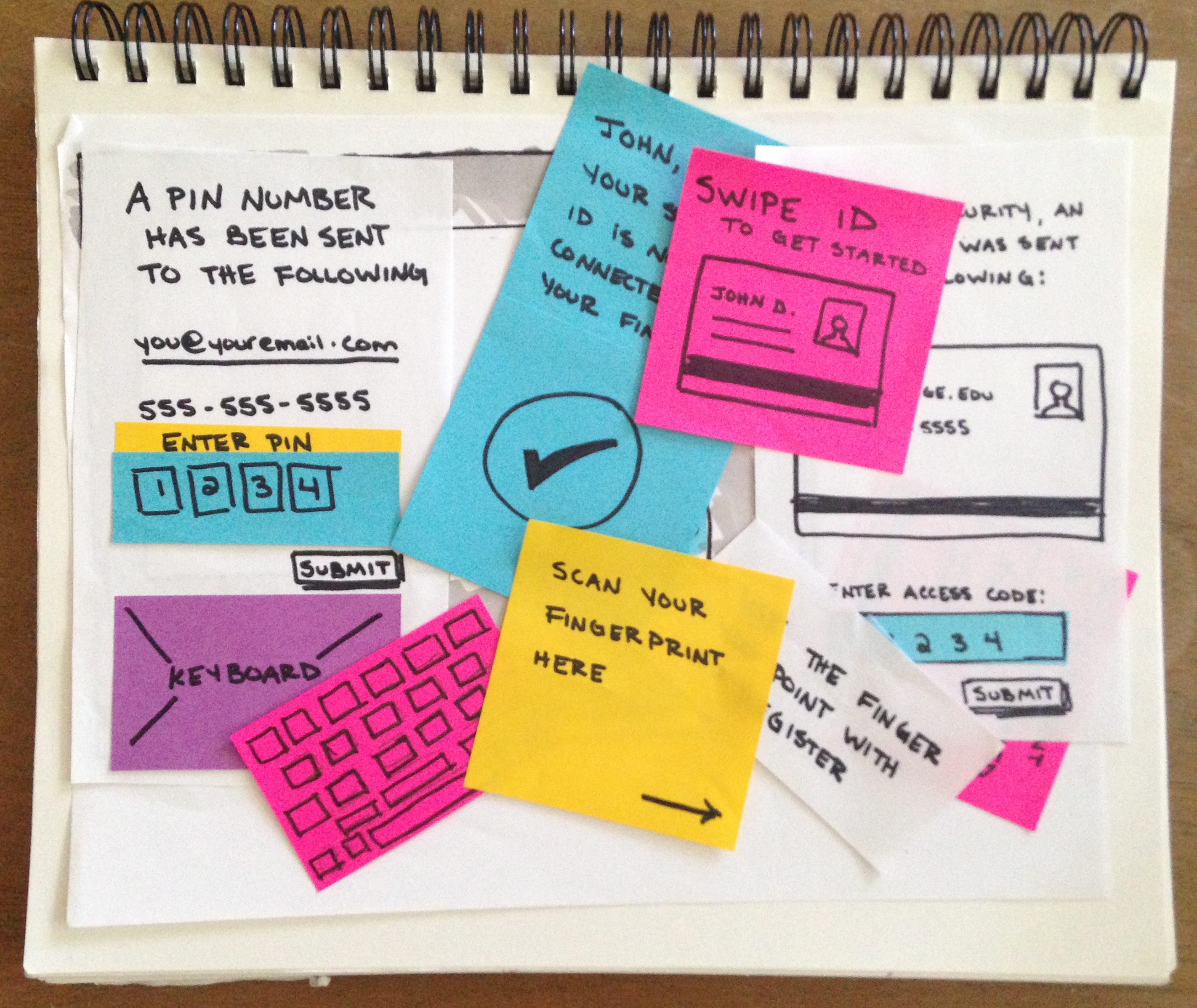
Definition: The technique of creating hand-drawn interfaces in order to quickly ideate, simulate, and test early design concepts.

Reference: It's literally as simple as a pencil and paper (and some multicolored post-it notes if you're feeling very adventurous.) Paper is great for tight budgets, fast iterations, and easy documentation. Some people believe that paper is not a reliable testing tool and that users will not take the "arts and crafts" look seriously. I would argue that because there is nothing precious about a dirty paper-prototype, users will be more open and inclined to offer true thoughts and opinions. Look for an example below by yours truly!

IMG_2977

Thoughts/Questions: Paper-prototyping is changing with the times and can now be incorporated into more robust applications, such as POP (takes photos of drawings and allows you to link up hot spots to simulate physical clicking and tapping). Do you think prototyping tools like this, which are created to enhance the simplistic and raw experience of paper-prototyping, elevate the gritty research technique or does it adversely affect the underlying nature of it?

January 9, 2015 - 2 comments

F-Pattern

Word:  F-Pattern

Definition: The natural eye movement by Western societies when scanning content rich webpages. Most people will automatically scan the top of a page, then skim down the lefthand side, and make a few occasional forays into into the center.

Reference: The pattern consistently appears during eye tracking sessions that use heat maps to follow a user's gaze. This word is best described with a picture so take a look below!

What does this have to do with design you ask? If you know and understand how a user most-often views a webpage, you can purposefully place specific content in the most effective areas for optimal attention.

Thoughts/Questions: The concept of an F-pattern has been understood for a long time and thrown around quite often.  However, webpages are taking on new formats and a typical webpage today does not look anything like what users saw even 5 years ago. Do you think the F-pattern will continue to have a strong influence on design moving forward?