All Posts in psychology

February 9, 2015 - Comments Off on Ockham’s Razor

Ockham’s Razor

Word: Ockham's Razor (sometimes Occam's Razor)

Definition: A philosophical rule about simplicity. The theory states that when choosing between multiple options, the simpler choice should be selected.

Reference: The theory is named for 14th-century theologian, William of Ockham and is used as a problem solving device.

Ockham's Razor helps justify and support design decisions. Jason Fried and David Heinemeier Hanson, the duo behind such software as Basecamp, utilize this principle in their work. They have been quoted saying,

"We design [our applications] to be simple because we believe most software is too complex: too many features, too many buttons, too much confusion."

While a simplistic feature set is not the solution to all design problems, it does not hurt to keep Ockham's razor in the back of your mind, especially when determining a feature set and product scope.

Question: How do you feel about simplistic design and utilizing such theories in UX practice? Where are the exceptions? What are the pitfalls?

February 7, 2015 - Comments Off on Sloth

Sloth

Word: Sloth

Definition: The avoidance of work and that feeling of "I don't care." Essentially, the idea that people only want to put in the most minimal amount of effort in order to achieve desired outcomes online.

Thoughts: The discussion here does not revolve around whether people are inherently lazy and instead speaks to how users feel about online tasks. Users are becoming more accustomed to great user experiences and are demanding easy-to-use, intuitive interfaces as a result. Steve Krug hit the nail on the head in his classic UX book  Don't Make Me Think. If there is an established way of completing certain tasks online, users will likely become agitated or simply not complete the task if it is made to seem too difficult. It all comes back to the user experience! When unnecessary effort is exhorted, putting laziness aside, the user is now in a new headset and this new frame of mind can negatively impact the experience as a whole.

Question: In what situations is it okay to push the user to exhort more effort? In these cases, what, if any, are the positive effects this can have on the user experience?

February 1, 2015 - Comments Off on Loss Aversion

Loss Aversion

Word: Loss aversion

Definition: The idea that loss is felt more acutely than gain and as a result, people overwhelmingly choose to avoid loss over acquiring gain. This principle contends with the theory of rational choice.

Reference: The term comes from economics and decision theory and was brought to light by psychologists Daniel Kahneman and Amos Tversky. They demonstrated that even something as simple as a coin toss can evoke aversion to loss. Kahneman discussed this concept in recent interviews describing, “In my classes, I say: ‘I’m going to toss a coin, and if it’s tails, you lose $10. How much would you have to gain on winning in order for this gamble to be acceptable to you? People want more than $20 before it is acceptable. And now I’ve been doing the same thing with executives or very rich people, asking about tossing a coin and losing $10,000 if it’s tails. And they want $20,000 before they’ll take the gamble.”

Essentially, people are willing to forego winning large amounts of money because the fear of losing, even when the amount is considerably less, is too consuming.

Thoughts/Questions: Designers use loss aversion in a variety of ways to evoke such feelings on their users. A great example is canceling subscriptions or services. If a users tries to delete her Facebook account she is shown images of her friends with the words "[Friend's name] will miss you!" Here, Facebook is trying to play into loss aversion by showing the user what she will be missing by leaving the service.

Everyone wants to be win, but we would much rather just not lose!

January 31, 2015 - Comments Off on Tom Sawyer Effect

Tom Sawyer Effect

Word: Tom Sawyer Effect

Definition: The Tom Sayer effect plays into two areas of user experience design. Firstly, it is the idea that scarcity breeds desire. If something is difficult to attain, people will covet it more strongly. Secondly, desire can often breed fun and delight, at which time, work no longer feels like work and transforms into enjoyment.

Reference: If it has been a while since you cracked Mark Twain's The Adventures of Tom Sawyer, let's refresh. At the beginning of the book Tom is tasked with white washing a huge fence, which quite obviously, is not how Tom wanted to spend his day. Instead of painting, he works his charm to convince neighborhood boys to do the job for him, and as an added bonus, even gets the boys to pay him for the privilege. So how did he do this?

When he offers the first boy the opportunity to paint the fence, Tom says, "Does a boy get a chance to whitewash a fence every day?" Here, Tom sets up a scarce opportunity. He then makes that scarce opportunity difficult to attain by telling the boy that there is no way he will be able to do a good enough job. "I reckon there ain't one boy in a thousand, maybe two thousand, that can do it in the way it's got to be done." So not only is the job scarce, but when presented the opportunity, it is still difficult to attain. Now Tom has the boy right where he wants him.

Tom finally allows the boy to white wash the fence, but in exchange for compensation! Here, Tom demonstrates the other principle of the effect, turning work into enjoyment. If Tom were to have paid the boy, the task would have turned right back into work.

Twain writes, "[Tom] discovered a great law of human action, without knowing it - namely, that in order to make a man or a boy covet a thing, it is only necessary to make the thing difficult to attain."

Thoughts: UX Designers can learn from young Tom Sawyer. Think about a website selling a product. Even if the product is not actually scarce, you can create that feeling of scarcity by limiting the time frame for purchase or even noting how many units of the item are sill in stock to evoke a fear of loss (more on loss aversion later).

We also see sites that rely heavily on user generated content. The user is typically not paid to post but excitement generated by the activity is enjoyable nonetheless. Especially, if you are specifically chosen to participate or receive a status that is difficult to attain (like ranking high up-votes on Reddit).

January 25, 2015 - Comments Off on Gestalt Laws of Grouping

Gestalt Laws of Grouping

Word:  Gestalt laws of grouping

Definition: A principle taken from psychology  to understand how people naturally observe and perceive object groupings. Gestalt psychologists believe that humans are predisposed into making sense of groupings in logical ways. The principles include perceived patterns like  proximity, similarity, closure, continuity, and common fate.

Reference: Gestalt is a German word roughly meaning "shape", "form", "essence", or "whole". Gestalt thinking gives people a lot of credit and theorizes that the human mind seeks to find structure and order in the world around it.

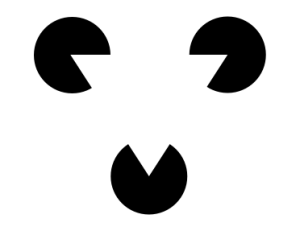
Take a look at the image below. What shape(s) do you see? Did you say, circles and a triangle? Why did you say that when there is obviously not really a triangle or a full circle present in the image? That, ladies and gentleman, is your mind working to make sense of an unknown grouping by referencing the known and understood. For further reference, the image is utilizing the principle of "closure".

gestaltExample


Thoughts/Questions: Understanding how people perceive and react to groupings of objects helps designers create layouts that are easily interpreted from user to user.

January 13, 2015 - Comments Off on Door-in-the-face

Door-in-the-face

Word:  Door-in-the-face

Definition: The notion that refusing a large request (figuratively getting the door slammed in your face) increases the likelihood of agreeing to a second, smaller request, shortly thereafter.

Reference:  A compliance method from social psychology, this technique works because of the principle of reciprocity (Cialdini et al, 1975). Saying "no" to a large request creates a feeling of guilt towards the asker, and in turn, the person being asked now feels as if she owes something. This manipulation strategy is often used in marketing.

The concept plays into design when dealing with  subscription fees or add-on purchases, for example. Think about a time when you bought an online subscription. There is often multiple packages to choose from. Once you've looked over the choices and deiced the expensive option is outrageous, you are more inclined to see the less expensive option as more reasonable in comparison. Hence, your guilty conscious may lead you to buy yet another unwanted and unneeded steaming music service!

Thoughts/Questions: As a user experience designer, where does your job end and the marketing department's job begin? Should a line be drawn between marketing tactics and what's best for the user?

January 12, 2015 - Comments Off on Hick’s Law

Hick’s Law

Word:  Hick's Law

Definition: The time it takes for person to make a decision increases with the number of choices available.

Reference: The law is named for British psychologist William Edmund Hick.

Countless studies in fields from psychology to marketing have investigated the affect of options on decision making and satisfaction (I suggest the jam study if you're looking for a good example). Widespread consensus shows that not only does fewer choices decrease time of decision making (a la Mr. Hick) but it also generates greater user satisfaction. The fewer the choices, the more satisfied the user is with her final decision. Seems counter intuitive, but science doesn't lie my friend.

Thoughts/Questions: While it is simple to see how Hick's Law is used in web design to justify menu and navigation decisions, you would be limiting yourself greatly if that is the only design feature influenced.  If you dig more deeply, you will see that decisions are the crux of experiences and impact every move and click a user takes on a site.

Is there ever a situation where it's better to give the user as many choices as possible? What would it be?

January 6, 2015 - Comments Off on Anchoring

Anchoring

Word:  Anchor

Definition: An anchor serves as a reference for comparisons.

Thought: Examples make understanding easier so here's one... When you buy a new phone your anchor point becomes $500. Therefore, when it comes time to buy a case for your new shiny toy, a $35 case doesn't feel like much in comparison to the anchor point. Now flip that around! If you bought the $35 case first (creating an anchor point), the $500 phone would feel like a lot more money.

What does this have to do with design? By understanding anchoring, designers are able to reset user expectations and assist in the arrangement or presentation of comparable items.

Question: Anchoring is commonly used on e-commerce sites to encourage consumer to purchase more products. I couldn't help but wonder... where do you draw the ethics line when it comes to your bottom line?