January 21, 2015 - Comments Off on Search Dominant Users
January 20, 2015 - Comments Off on Secondary Navigation
Secondary Navigation
Word: Secondary Navigation
Definition: Directing links on a website or application that represents information that is of secondary interest to the user.
Thoughts: Great examples of secondary navigation are pages that sites feel obligated to offer such as "FAQ" and "About Us". This is not to downplay the importance of such links, which are helpful in their moments, but for the most part, a user has not arrived on your site just to read your "About Us" section. Larger websites like your Home Depots or your Amazons need these tiered navigational schema because of the plethora of navigational choices. Regardless of site size, tread lightly and choose your navigations thoughtfully and purposefully.
Question: If secondary information is so secondary, does it even belong at the top of the page (the typical location)? Is the footer more appropriate? If the footer, is it still considered secondary navigation?
January 19, 2015 - Comments Off on Primary Navigation
Primary Navigation
Word: Primary Navigation
Definition: Directing links on a website or application that (most typically) appear above the fold, are displayed near the top of the page, and represents the content that is most relevant to the user.
Thoughts: Primary navigation can usually be found just below the logo and header and is always displayed prominently. Navigation is key to way-finding and acts as a constant and comforting presence to orient the user.
Question: Is primary navigation a left-over relic of interets-past? What will be the role of primary navigation on our infinite and parallax scrolling future?
January 18, 2015 - Comments Off on Breadcrumbs
Breadcrumbs
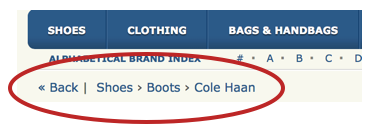
Definition: A type of secondary navigation used for way-finding in order to reveal the user's location within a website or application. Breadcrumbs prove to be especially helpful when landing on a page out of context or not arriving initially through a homepage.
Thought: Breadcrumbs are seen and used most often on large websites full of copious amounts of information, like e-commerce sites. However, it seems that the trend for breadcrumbs may be fading fast and the pattern is not as strong or significant as it was, say, three years ago.
It is important to keep an eye out for such trends because, like in any other constantly and evolving field, patterns go in and out of style. I mentioned it here because it is an important term to know and understand when discussing way-finding and navigational context even if the pattern may not be as widely used.
Question: What do you think; are breadcrumbs still an impactful and/or a relevant UI pattern?
January 17, 2015 - Comments Off on User Journey
User Journey
Word: User Journey
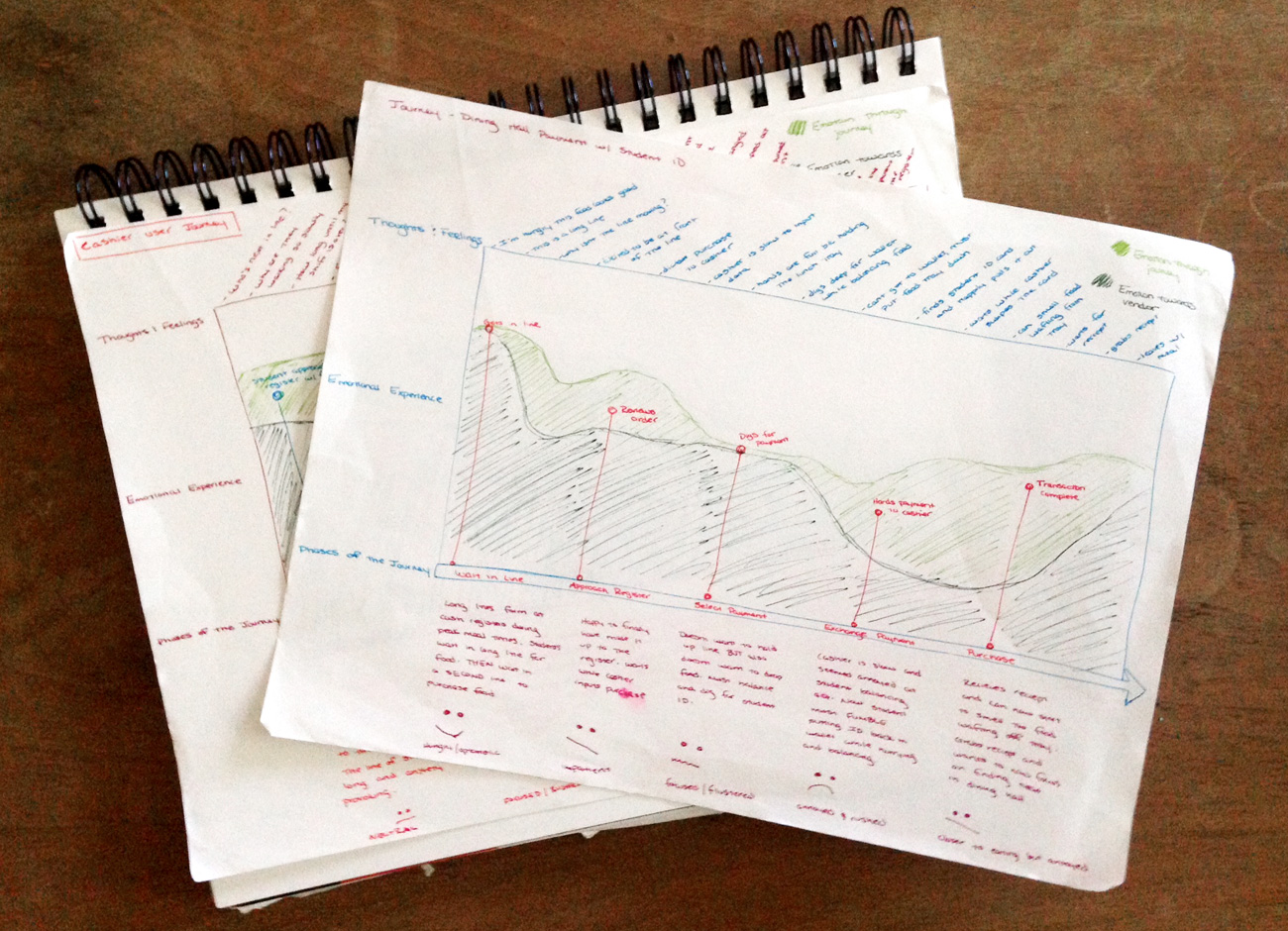
Definition: A map or diagram that illustrates the story of how a user experiences and interacts with a product or company. The story can be a small portion of the experience or an all-encompassing overview in order to provide insights into the user's thoughts, feelings, and motivations.
Thought: User journeys are helpful to many people within a company, but the key takeaways for UX practitioners include uncovering pain points, understanding the user's unique perspective, and providing insight into user's decision making.
There is no formula for a user journey map. They can take any format you like, so long as it is simple and readable. This could be a timeline, an infographic, or a storyboard.
Word of warning, user journeys should be created from research and gathered information from users. This is not a free-form art class. No one is interested in your thoughts or speculations here.
Below is an example of one that I did a while back if you need an example
Question: Are we at a point yet where this tool is universally accepted by teams outside of design or, are UXers still barring the heavy-lift in selling the importance of these documents to stakeholders?
January 16, 2015 - Comments Off on Gamification
Gamification
Word: Gamification
Definition: The use of game elements and design features in a non-gaming context in order to solve problems, like in a business for example.
Thought: Three strong components of gamification that have spread rapidly through the digital design industry are validation, completion, and prizes.
Validation is like retweets, up-votes, and likes. Validation drives engagement and strengthens the sense of community.
Completion, just like working your way through a game level, can be seen applied to anything from your Linkedin profile percentage to hitting a step-count on a fitness tracker.
Prizes are used as incentives to focus the user and help her see a task through to completion. A great example is earning badges and avatars on the language learning application Duolingo.
Question: While these are just three examples, it is easy to see how gamification has infiltrated our digital lives. Now that gamification is all around us, will this diminish its powerful effect? Have we already over-used this technique to a point-of-no-return?
January 15, 2015 - Comments Off on Feature Creep
Feature Creep
Word: Feature Creep
Definition: The ongoing addition of new features to a product that tends to result in over-complication and loss of initial focus and purpose.
Thought: Feature creep is the exact reason why it's important to identify an MVP (Most Viable Product) and stick with it. This is the time to excise self-control. Pick your most important features to build out, and then build only those. As soon as you start introducing new and unnecessary additions, you're product will lose its focus which can be disastrous. That is my PSA, please know you have been warned.
Question: Can you think of a great but simple product that was ruined by feature creep?
January 14, 2015 - Comments Off on Paper Prototyping
Paper Prototyping
Word: Paper Prototyping
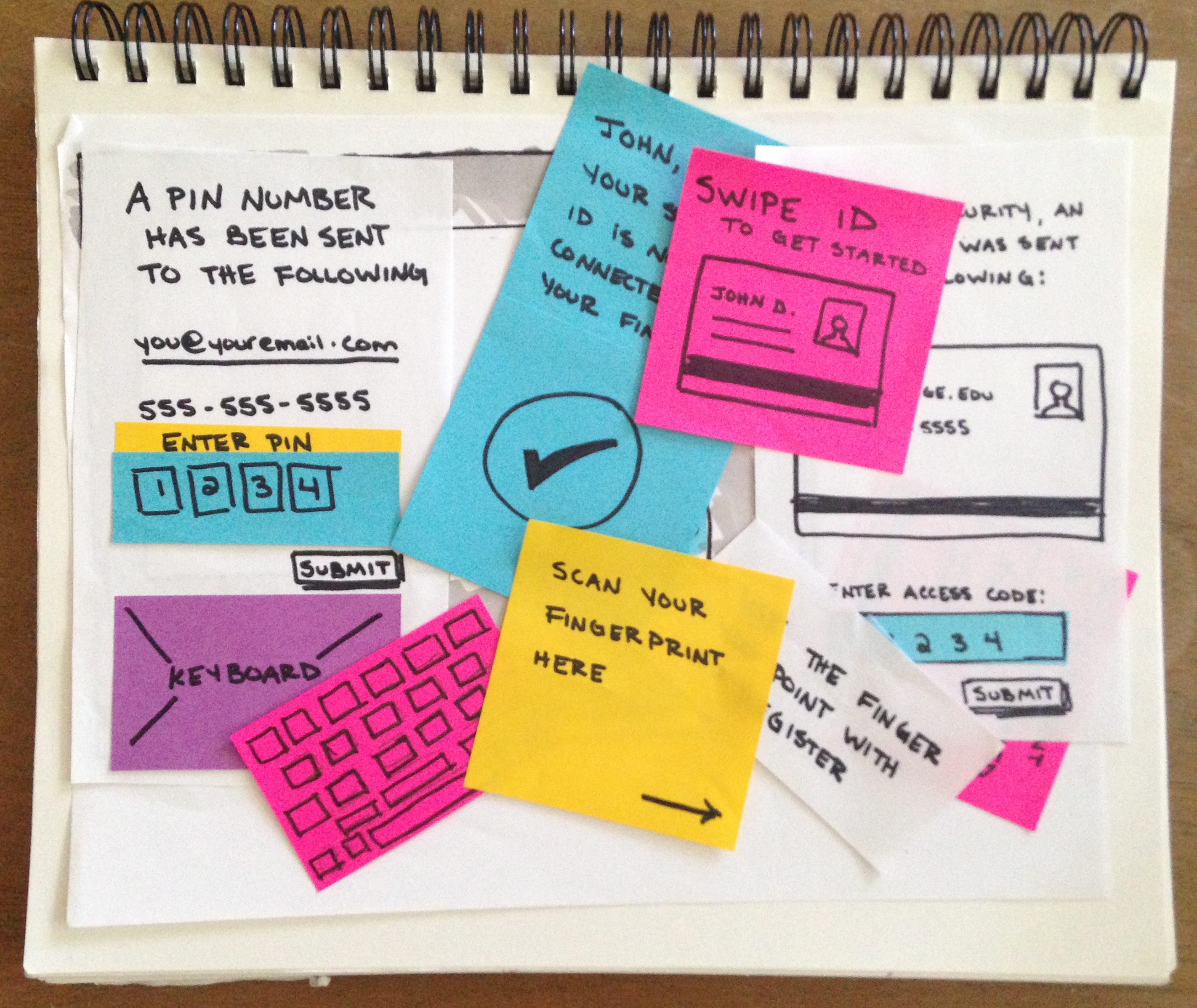
Definition: The technique of creating hand-drawn interfaces in order to quickly ideate, simulate, and test early design concepts.
Reference: It's literally as simple as a pencil and paper (and some multicolored post-it notes if you're feeling very adventurous.) Paper is great for tight budgets, fast iterations, and easy documentation. Some people believe that paper is not a reliable testing tool and that users will not take the "arts and crafts" look seriously. I would argue that because there is nothing precious about a dirty paper-prototype, users will be more open and inclined to offer true thoughts and opinions. Look for an example below by yours truly!
Thoughts/Questions: Paper-prototyping is changing with the times and can now be incorporated into more robust applications, such as POP (takes photos of drawings and allows you to link up hot spots to simulate physical clicking and tapping). Do you think prototyping tools like this, which are created to enhance the simplistic and raw experience of paper-prototyping, elevate the gritty research technique or does it adversely affect the underlying nature of it?
January 13, 2015 - Comments Off on Door-in-the-face
Door-in-the-face
Word: Door-in-the-face
Definition: The notion that refusing a large request (figuratively getting the door slammed in your face) increases the likelihood of agreeing to a second, smaller request, shortly thereafter.
Reference: A compliance method from social psychology, this technique works because of the principle of reciprocity (Cialdini et al, 1975). Saying "no" to a large request creates a feeling of guilt towards the asker, and in turn, the person being asked now feels as if she owes something. This manipulation strategy is often used in marketing.
The concept plays into design when dealing with subscription fees or add-on purchases, for example. Think about a time when you bought an online subscription. There is often multiple packages to choose from. Once you've looked over the choices and deiced the expensive option is outrageous, you are more inclined to see the less expensive option as more reasonable in comparison. Hence, your guilty conscious may lead you to buy yet another unwanted and unneeded steaming music service!
Thoughts/Questions: As a user experience designer, where does your job end and the marketing department's job begin? Should a line be drawn between marketing tactics and what's best for the user?
January 12, 2015 - Comments Off on Hick’s Law
Hick’s Law
Word: Hick's Law
Definition: The time it takes for person to make a decision increases with the number of choices available.
Reference: The law is named for British psychologist William Edmund Hick.
Countless studies in fields from psychology to marketing have investigated the affect of options on decision making and satisfaction (I suggest the jam study if you're looking for a good example). Widespread consensus shows that not only does fewer choices decrease time of decision making (a la Mr. Hick) but it also generates greater user satisfaction. The fewer the choices, the more satisfied the user is with her final decision. Seems counter intuitive, but science doesn't lie my friend.
Thoughts/Questions: While it is simple to see how Hick's Law is used in web design to justify menu and navigation decisions, you would be limiting yourself greatly if that is the only design feature influenced. If you dig more deeply, you will see that decisions are the crux of experiences and impact every move and click a user takes on a site.
Is there ever a situation where it's better to give the user as many choices as possible? What would it be?